
Choose among connected forward stops by the team’s immediate need, then check whether that branch reaches a useful campfire or shop. There is no tested best route for every run.
Basis: Official help read October 9, 2026. Video published October 2, 2026; recorded build unknown. Video examples describe that run, not guaranteed current outcomes.
Choose among connected forward stops by the team’s immediate need, then check whether that branch reaches a useful campfire or shop. There is no tested best route for every run.
On this page
Which options can you actually take?
Only stops connected to the current node are selectable. You cannot backtrack. A route recommendation therefore has to fit the map in front of you, not a fixed sequence from another run.
Ordinary fights scale to the team’s average level according to the current help. Benching a strong Pokémon is not described as a way to lower encounter levels.
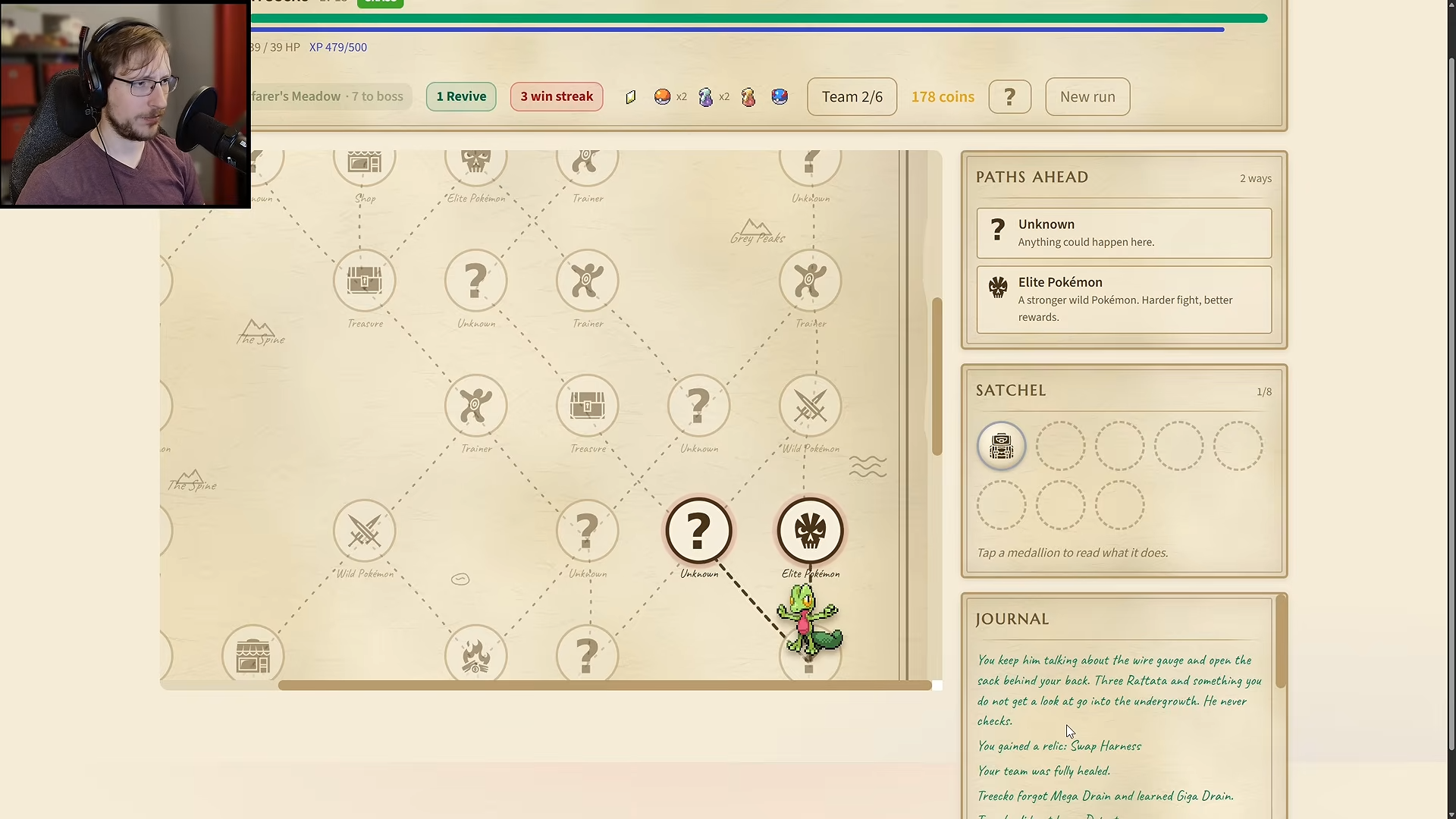
Recorded at 08:07. TheDuoDesign; build unknown. The image supports the displayed screen only.
TheDuoDesign · View sourceTheDuoDesign’s recorded run, published October 2, 2026 (US). The build is unknown; this segment illustrates one run, not a universal outcome.
TheDuoDesign · Source / open if playback failsHow should you compare reachable branches?
The following choices are recommendations based on documented node functions; they are not measured win-rate rankings.
Recovery is urgent
Compare the branch reaching a campfire with another fight
Campfires offer 50% healing and establish loss checkpoints.
Balls or healing supplies are low
Consider a reachable shop if you have Coins
Shops sell the documented supplies.
You want another team member
Consider a Wild encounter
Wild wins can lead to a catch attempt.
An Elite lies ahead
Review health, moves and loss protection first
The help describes a stronger fight with better rewards.
What is the cost of taking a risky branch?
If a battle loss consumes a Revive, the help describes a return to the last campfire in the current act with half HP and half Coins lost. Without a campfire, the return is the act start. Without a Revive, the run ends.
This makes checkpoint access relevant to route choice, but does not establish that every safe-looking branch is optimal.
Plan your next decision
Continue with the guide that matches the resources or action you need next.