
Keep up to six Pokémon in your active party; overflow catches enter the Box. Recheck usable attacks and recovery after a catch, new move or evolution, and manage party and Box choices at Rest Stops.
- Judge readiness by current moves and PP.
- Check attack coverage separately from species types.
- Ordinary fights scale to average team level.
- Rotation advice does not imply switching is a free action.
Basis: Official help checked October 9, 2026. Video examples show one run with an unknown recorded build. Conditional recommendations and arithmetic examples are planning advice, not comparative gameplay tests.
Build a party that can keep fighting, then add usable attack options. Inspect HP, PP and current moves in Team; filling six slots does not automatically cover the next matchup.
On this page
How should you plan six party slots?
List each member’s current HP, available attacks and PP in Team. Identify who can finish the next fight and what the other members contribute. A future evolution or move cannot fill a role before it is available.
Six slots are a limit rather than a requirement to fill immediately. Address a gap before spending a ball on another similar member. An overflow catch enters the Box and requires a later party-management decision.
Update the party in this order
After a fight, inspect who is still usable, then review any new move, catch or evolution. Give a move replacement a purpose: another attack type, another usable attack, or a different function. The 14:08 Thief prompt shows four existing moves and a decline option, illustrating why learning every offer is not an automatic upgrade.
A purchased TM enters the Bag; teach it to a member through Team. Use evolution stones on a compatible member in Team as well. Confirm the move or form has changed before counting that upgrade in the next-battle plan.
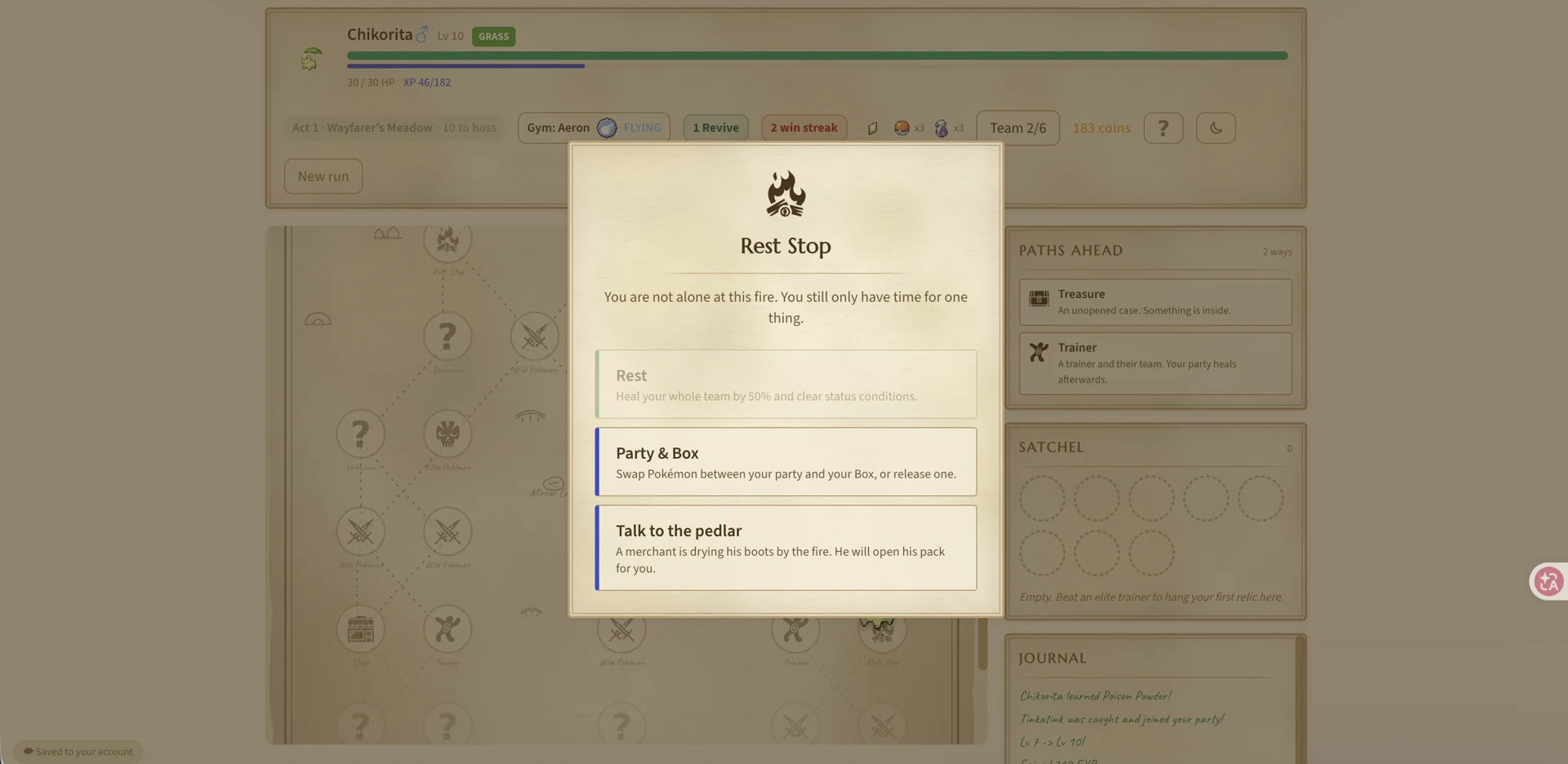
Player-provided capture, October 9, 2026. This still shows the visible interface; the game build and later outcome are not established.
Player-provided gameplay · View full screenshotWhy can a full party still struggle?
Repeated attack options, depleted PP and injured members can leave a six-member party with only one practical choice. Separate party size from battle readiness. Official help says ordinary fights scale to average team level and benching your strongest member does not make the road easier.
| Symptom | Next action |
|---|---|
| Everyone relies on one attack option | Prioritize a different usable move or member |
| Lead and alternatives are hurt | Use a reachable Rest Stop or available healing supplies |
| Useful moves are low on PP | Review remaining attacks before treating the member as ready |
| A new catch entered the Box | Manage it at a Rest Stop; do not assume it joined the active six |
Why does a win not always restore full HP?
Winning restores 60% of the damage taken in that fight. A 40-HP loss would therefore restore 24 HP and leave a 16-HP net loss under that rule, before other recovery effects. This is an arithmetic example, not a promise to heal 60% of maximum HP.
Trainer nodes separately describe a party heal without a complete formula. Read actual HP before the next branch. Status conditions persist between turns, so do not assume a win clears them; budget healing and alternative members.
Which relic description fits your party?
Match relic descriptions to attacks your party actually uses. Public client descriptions associate Heavy Fist with physical damage, Focus Lens with special damage and Type Prism with moves matching the member’s first type. Do not infer an attack category from a species appearance or expand the first-type condition to every type.
These descriptions support conditional choices, not a tested best combination. Check whether current moves qualify after taking a relic. If they do not, consider it in later changes rather than discarding a usable party solely to activate one description.
Improve attacks or recover first?
Use the move guide for missing attack options. Use recovery and Box management for unavailable members. If the plan depends on evolution, confirm its requirement and purchase budget before progressing.
Frequently Asked Questions
Is a differently typed member always better?
No. Compare usable moves, condition and the actual gap; species type alone does not establish attack coverage.
Can benching my strongest member lower enemy levels?
Official help explicitly says this does not make the road easier; ordinary fights scale to average team level.
Sources
- Official How to play — read October 9, 2026
- TheDuoDesign — recorded gameplay, October 2, 2026
- Gameplay: 06:37 visible relic choice
- Gameplay: 10:00 frame
- Gameplay: 14:30 frame
- Gameplay: 21:34 frame
- User-provided Discord transcript; original dates and build unknown
- Player-provided screenshot — October 9, 2026